
You have several blocks to visit and limited time
Use Farmbit to decide which block should get the first hour instead of defaulting to the loudest complaint or the nearest driveway.
Advisor fit
Published March 18, 2026
Farmbit is useful before a field visit, not instead of one. Use it to narrow which block deserves the first stop, what the likely issue might be, and whether the visit should stay simple or escalate into something closer.
Suggested sequence
Where it helps
Use Farmbit to decide which block should get the first hour instead of defaulting to the loudest complaint or the nearest driveway.
Send the ranked zones ahead of time so the grower and crew know where you are likely to start once you are on site.
Use the free pass to decide whether the block looks directionally real before anyone pays for drone mapping or asks the crew for more collection.
What the advisor gets
What it does not replace
Public result proof
The same brief structure used in real field runs.
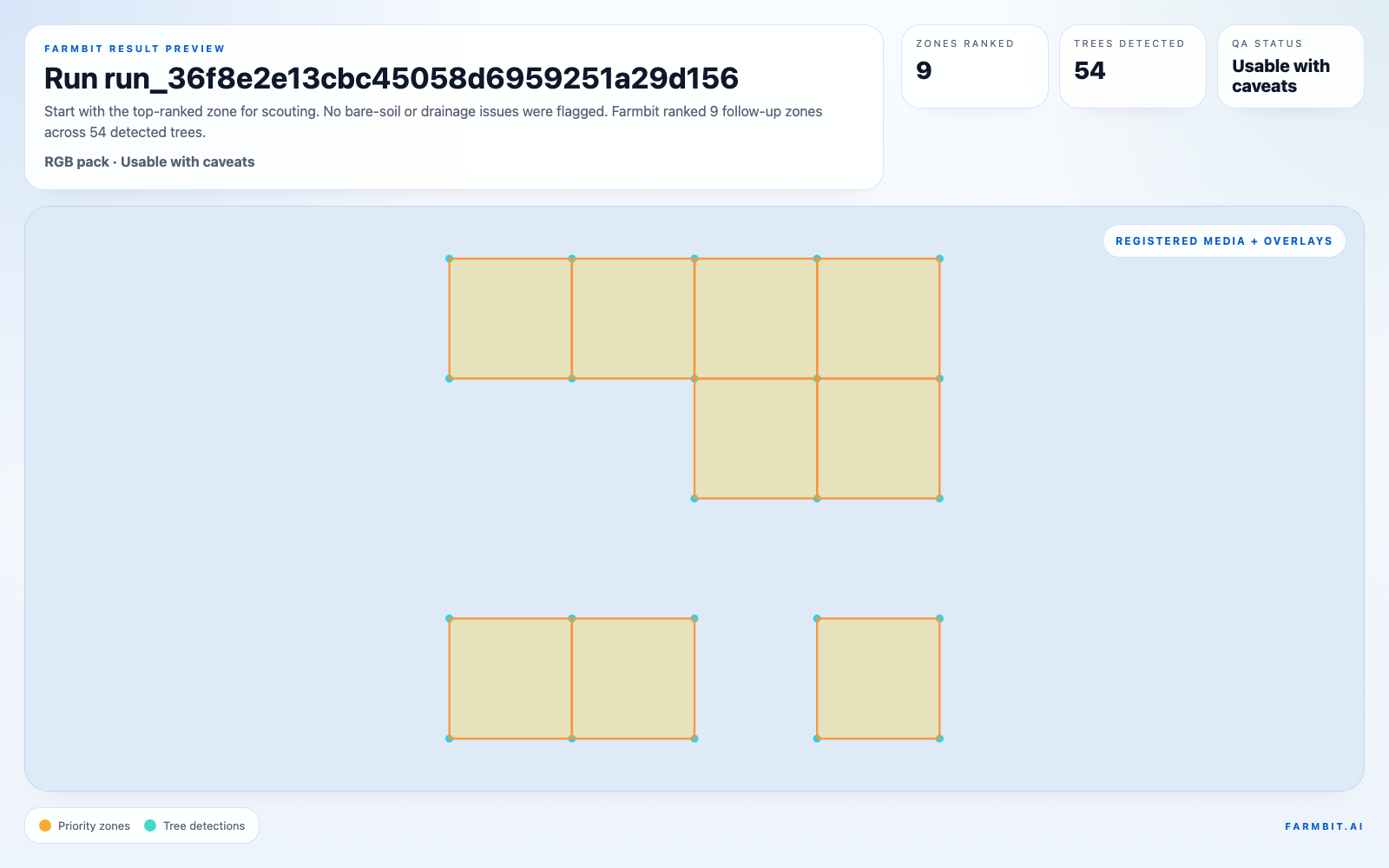
Result page
Open the same result page a crew lead would use before leaving the yard.
Crew brief
Read the short PDF that tells the crew what to verify on the ground.
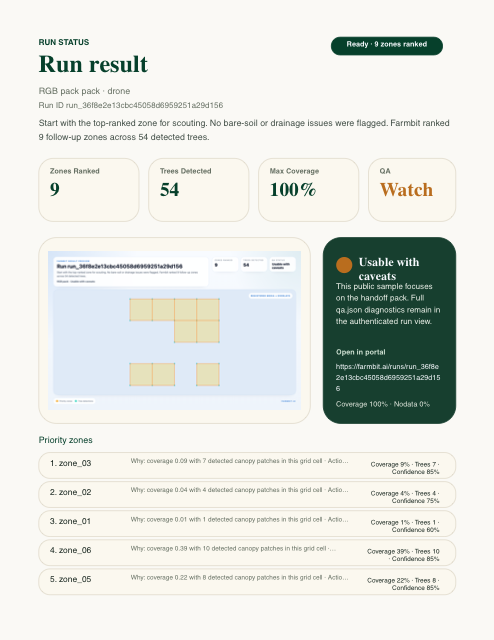
Preview image is for proof. Open the PDF for the full report pages.
Result page
Open the same result page a crew lead would use before leaving the yard.
Crew brief
Read the short PDF that tells the crew what to verify on the ground.
Priority map
Send the same scouting boundary to an advisor or GIS tool.
FAQ
When you have more than one block competing for attention and want a better first stop before the day gets consumed by travel and walking.
After the free pass and the first walk both keep pointing back to the same block and you still need tighter structure before advising action.
No. It gives you a better starting point and a reusable field brief, but the advisor's judgment still closes the loop.
Next step
The fastest way to judge advisor fit is to inspect the public sample first, then run the free check on the next block that is likely to shape your visit.